We have sent the first part of the long list of locations that the cyclists of Hong Kong would like to see cycling unbanned. There’s more locations we will send later, but these will get the discussion started.
If you have more locations that you would like us to request for cycling to be unbanned, you can use this page to look at the locations we have so far and send us a location if it is not included already.
We at Hong Kong Cycling Alliance are very proud to be a part of the first ever Hong Kong Bicycle Film Festival on 10th-13th January, and with the tickets on sale today, we’ll be rushing to get our seats booked..!
Cycling has recently become not just a trend but also a culture. The Bicycle Film Festival features a collection of independent film productions from around the globe, telling tales of joy and tears about cycling. The 2011 world tour drew an audience of over 300,000 from over 20 cities around the world. Held in Hong Kong this time, the festival coincides with the city’s post-Olympics cycling fever, opening up to the local community the infinite possibilities about cycling beyond the countryside cycling tracks.
對白以英語為主,非英語對白將附設英文字幕。
Dialogue is mainly in English. Non English soundtracks will have English subtitles.
The Road Safety Council recently changed its guidance regarding where cyclists should be in the roadspace. It now tells cyclists to be in the middle of any narrow lane (ie. when another vehicle cannot safely be alongside within the lane) or when you are approaching a turn.
On Hong Kong’s confined streets, this has many benefits: it makes you much more visible to drivers, gives you some space on your left when vehicles come too close, and ensures that drivers think before they overtake you rather than believing they can “just squeeze past” when you are nearer the kerb.
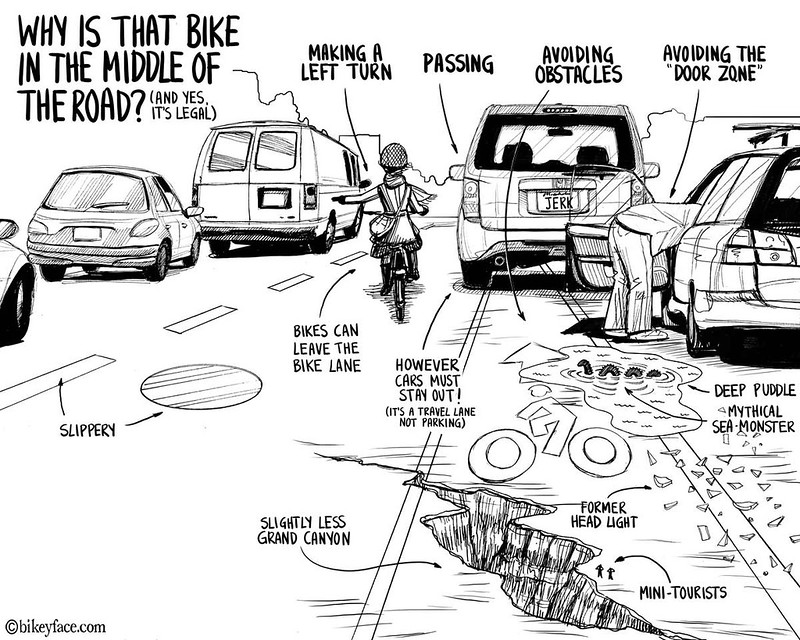
Whenever a person first discovers I bike, they reply with a story. And it’s always the same story.
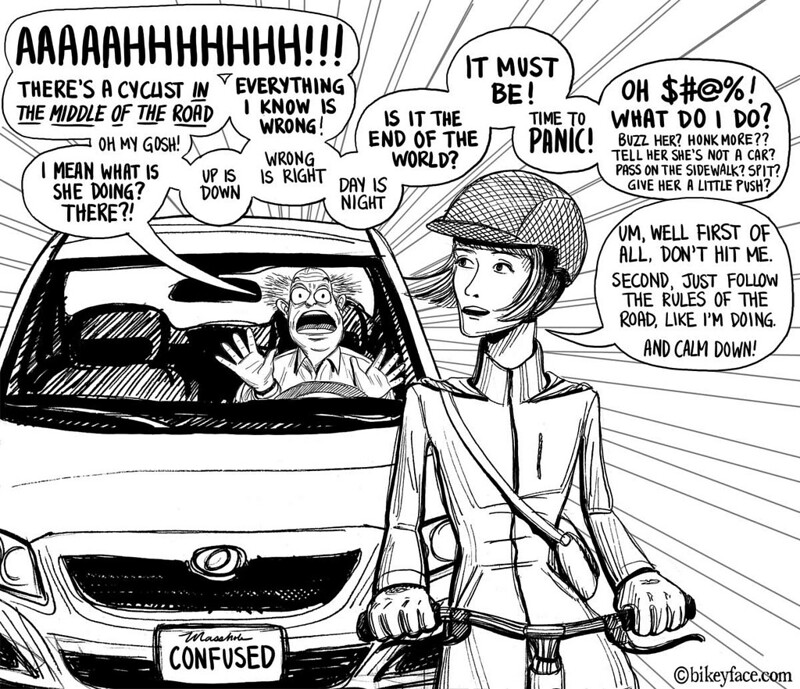
“I was driving down [insert any road name] when all of the sudden I saw a cyclist in the MIDDLE OF THE ROAD!” Inevitably it always ends with them saying they “just tapped on their horn” or “squeezed by” or “yelled out to the cyclist.”
And many many times I’ve been the cyclist in one of these stories – the one sharing the road with a driver that isn’t aware of the basic road rules regarding bikes.
What’s worse is that sometimes reasonable people panic at the sight of a bicycle in the lane… and then all that reason flies out the window.
So I wanted to explain it to those who have never biked in the city:
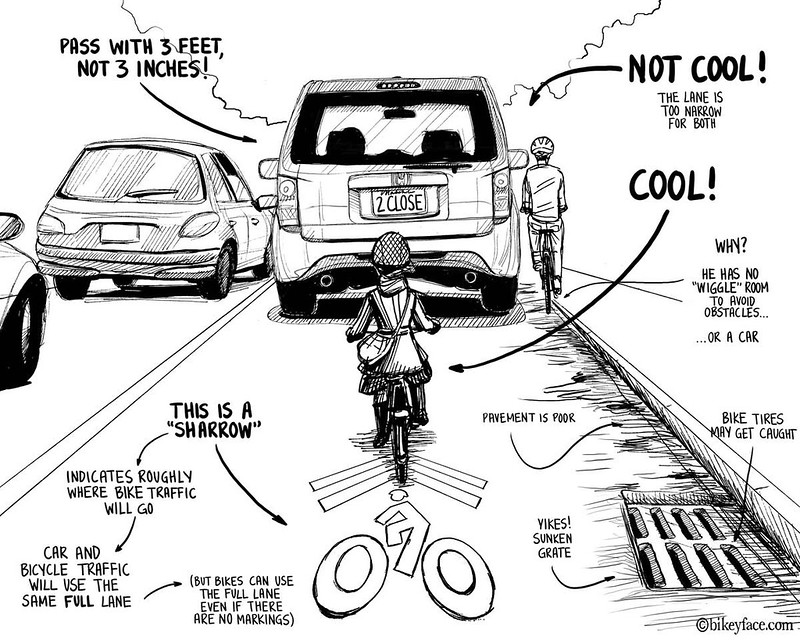
And there’s more. Bikes are small, but they still need space. Cars should give cyclists the same amount of space when passing as another vehicle, at least 3 ft. However, not all roads allow for that, particularly in Boston:
So don’t panic when you see a bike in your lane. Just treat it like another vehicle. If you can pass safely, that’s fine. If not, most likely you won’t be slowed down much if at all. In the city, I find that car traffic slows me down much more than the other way around.
為宣揚香港渴求健康空氣的訊息,並鼓勵大眾多使用無空氣污染排放的交通工具,「健康空氣行動」(Clean Air Network )會於12月2日下午舉辦一個名為「綠悠遊 Clean Air Drive」的活動,活動集合一眾人士騎乘電動車、單車及其他零污染交通工具,由九龍灣零碳天地(九龍灣常悅道,MegaBox旁)出發,沿一條特別路線遊走,如果從高空向下望,該路線會畫出 A I R 三個英文大字,藉此宣揚香港渴求健康空氣的訊息。
As Boulder edges out Portland for the title of North America’s most bike friendly city (in one ranking, anyway), and Amsterdam and Copenhagen jostle for the European cycling crown, we ask ourselves, how do Asia’s cities measure up for getting around on two wheels?
Beijing is the capital of the world’s most cycling-rich country, and still designed for bikes. Its cycling modal share may have dropped from 63% to 17% but could improve again soon –the city government aims to boost it to 23% by 2015. Hangzhou has the world’s largest public bike share scheme, with an incredible 65,000 bikes at 2400 rental stations. And Kunming is appreciated by those that ride there; it has a comfortable pace of life, and plenty of space. Across the water, Kyoto is a functional cycling city with a dash of European style – it’s normal to ride everywhere around town, dressed for the destination, not the vehicle.
Taiwan is on everyone’s cycling radar these days: Taipei has a wonderful network of paths, and the Kaohsiungpublic bike share scheme is fab. The city has 150 km of tracks and a lot of the back streets are free of road markings, so everyone drives gently and looks out for everyone else. Even in Singapore, the government took the step that Hong Kong first needs to: publicly stating that cycling is transport, and then implementing measures to facilitate it. They’ve been a bit quiet about it recently though.
Melbourne gets rated highly. It’s flat and there’s a modest bike share scheme in the city centre. The 200+ km Around the Bay in a Day event draws the crowds and raises cycling’s profile. But Australia’s mandatory helmets law adds hassle for newcomers. In fun places like Bali or Chiang Mai, cycling is widespread and effective, and certainly friendly, but it’s not quite urban cycling.
One from the back pocket: three years ago, authorities in Seoul announced that the city would increase bicycle use from 1.6 percent to 10 percent by 2020. How are they doing?
What about Pyongyang? The roads are blessedly free of cars (since no one can afford them) and 70% of North Korean households rely on their bikes to get around. Plus, the new, young, just-possibly-normal leader, Kim Jong Un, recently rescinded the 16-year ban on women riding bikes (though it was introduced after the hit-and-run death of the daughter of a prominent general as she cycled in the capital).
And what does Hong Kong have to do to be a contender? The administration’s negligent contribution is a handicap of course. But huge numbers of people cycle anyway, for transport and enjoyment, and both the urban areas and countryside offer huge potential for getting around on two wheels. Shouldn’t enthusiastic and increasing participation count for us, or at least boost our chances for the future? And will the government see the light some time soon?
An interesting new report from Civic Exchange takes a detailed look at how we should be moving around – and enjoying – our built space, here in Hong Kong. It focuses on walking but embraces cycling as part of a much-needed shift in thinking towards personal mobility. Cycling and walking are together at the core of a global change in urban planning that is sadly not yet seriously encountered within the realm of .gov.hk.
The report points out that, increasingly, other world cities are improving transport by making “more priority to cycling and walking” a policy goal. The quote is from Melbourne, but similar examples from London, New York, Seoul, Toronto and many others are included.
If reading this study makes you want a more cyclable, as well as a more walkable, Hong Kong, and you’d like to be a part of making it happen, please contact us!
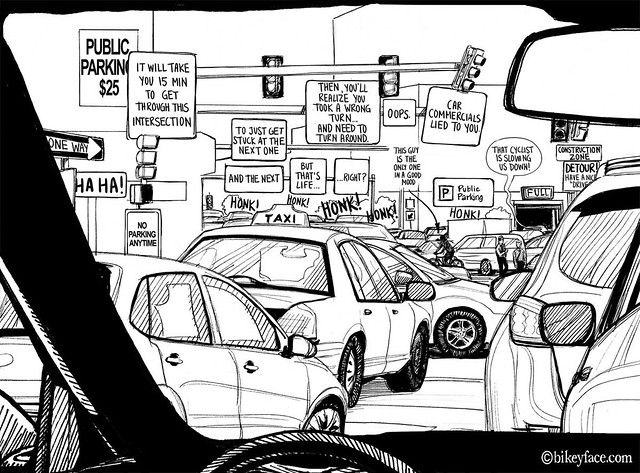
I bike pretty much everywhere in the city these days. But I also have a driver’s license and 16 years of driving experience. And occasionally I still drive. Like the other day I ended up driving across town to run an errand. Now, if you live anywhere near a city, you know that the driving experience is not exactly as advertised:
It’s a little bit more like this:
Which is not a good advertisement for cars. But this is exactly what I found myself driving in.
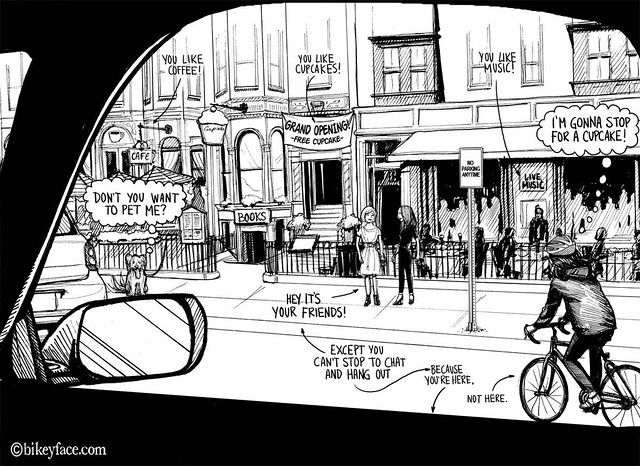
After my errand, I decided I wanted to stay out. I was hungry and there are great restaurants downtown. And some shops too. (I know, because I discovered them all by bike.) But in a car, I realized that I couldn’tcasually go to any of them. I was trapped…
…and had to pass them by. It was like I was carrying the weight of the car rather than it carrying me. And I was tired. So I went straight home instead. Cars are useful, but driving in a city is kind of like trying to thread a needle while wearing a boxing glove.
We’ve seen a copy of an internal guideline of KMB allowing folded bicycles of less than 0.1m3 in size to be brought on their buses. The requirement is to make bicycle a carry-on luggage. We wonder how useful is that guideline for people who want to bring their bicycles on buses. Here is a simple survey to see which bicycles can fit in the 0.1m3 requirement.
Please tell us how big is your bicycle (in m3) and what is the make by replying this post.
To calculate the volume of the bicycle in folded condition, just measure its length (L), height (H) and width (W) in metre and then multiply all 3 measurements. That is: length (m) x height (m) and width (m) = volume (m3)
Great thanks go to Matteo for allowing us to use his photo of the delivery cyclist. He writes on his own blog about riding vintage Fuji bikes "There is something special about these vintage fuji bicycles. It is inexplainable, but it is real. They are quality. They are beautiful. They surpass expectation.". See more at Fuji Crazy
Many thanks also to Christopher Dewolf for his photo of cycling at sunset in Ma on Shan. His photos can be found at his Flickr Site, and some of his many writings & photos can be found at Urbanphoto.net
Huge Thanks to Jason Findlay for the photo of the Harbourfront bike Ride 5 near Causeway Bay Typhoon Shelter